


You want a system that actually builds speaking skills without burning out. We’ll show a clear path that balances input, output, vocabulary, grammar, and steady practice. This approach values smart systems over shortcuts.
Research shows combining understandable input with interaction and some focused grammar boosts accuracy more than input alone. Short, corrected conversations often beat long passive study for progress and motivation.
Our plan fits your life and links daily actions to real outcomes. Expect routines that protect your time, keep motivation high, and recycle vocabulary so words become usable sentences fast.
Key Takeaways
- Mix meaningful input with active speaking and light form focus for real progress.
- Short, corrected practice yields faster gains than extra passive hours.
- Daily mini habits beat irregular marathon sessions.
- Systems—clear goals, feedback, and consistency—outperform random tactics.
- We’ll map a step-by-step plan so you can target useful vocabulary and speak with confidence.
What “Effective and Sustainable” Language Learning Really Means
Sustainable progress in language comes from small, regular actions that match what you care about. You need clear goals, tools you enjoy, and a plan that reduces friction. When these fit your routine, motivation stays steady and learning compounds.
From motivation to method: start with a simple target and build tiny habits. Short daily practice, like five minutes of listening and five minutes of speaking, beats irregular marathon sessions. That keeps effort manageable and wins frequent rewards.
Evidence-backed pillars: research supports three linked parts. Comprehensible input (Krashen) grows intuition. Meaningful output (Swain, Long) exposes gaps and triggers learning. Focused form work (Lightbown & Spada) tightens accuracy when you are ready.
“Meaningful use from the start plus explicit teaching of key forms produces better accuracy than input or drills alone.”
- Input builds speed and context.
- Output shows what you need to fix.
- Targeted grammar follows natural developmental sequences.
We’ll turn these ideas into a weekly plan that balances input, output, vocabulary, and light study. That system helps learners keep momentum and reach real targets without burnout.
The Best Way to Learn a Language: Why Systems Beat Hacks
Quick hacks can feel useful, but they rarely create lasting skill. Research shows that combining input, interaction, and focused instruction creates reliable gains rather than fleeting wins. Systems plan practice, guide feedback, and prevent errors from hardening.
What research says about input-only vs interaction and explicit instruction
Input-only programs raise comprehension and sometimes speaking accuracy. Still, studies — including Canadian French immersion research — found persistent spoken grammar errors without targeted form work.
Explicit instruction matched to your level closes that gap and speeds accuracy gains.
The role of feedback and real conversations with native speakers
Interaction forces real-time retrieval and negotiation of meaning. Feedback matters: corrected conversation rewires patterns far faster than passive review.
“A single hour of corrected conversation can rival multiple hours of solo study.”
Systems make these high-ROI moments routine: scheduled sessions with native speakers, queued audio and book input at your target level, and short post-conversation drills that convert mistakes into learning gains.
- Hacks promise shortcuts; systems produce progress.
- Mix input, interaction, and timely grammar focus.
- Use feedback from real conversation to guide your next study session.
Your Step-by-Step System: From First Words to Confident Conversations
Start with one clear, emotional reason and your routines gain direction. This gives you immediate motivation and makes each tiny action meaningful for your language learning.
Stage one: set a tangible why and narrow, measurable goals
Tie your effort to a real outcome—travel dates, family chats, or a test. Pick one narrow target you can measure this week and list the phrases you need first.
Stage two: build a daily cadence and track streaks, not hours
Design mini habits anchored to daily anchors: morning coffee listening, lunch review, and a weekly tutor slot. Track streaks so one short day beats no day. Preload your queue — podcast, short story, and a speaking slot — so you can get started without decision fatigue.
Stage three: iterate with feedback loops and targeted practice
Log errors from conversations, spot patterns, and make 10–15 minute drills that fix them. Recycle core words into many sentences and run a weekly review to celebrate wins and adjust practice, not the goal.
- Use time boxes: 15-minute input, 10-minute vocab, 15-minute speaking.
- Start heavy on input for a month, then shift weight toward output.
- Tools like LangAdvance can track goals, maintain streaks, and turn tutor feedback into the next week’s study.
“Small, consistent actions tied to one clear why beat sporadic effort every time.”
Mastering Input: Comprehensible Reading and Listening That Stick
Good input nudges your brain—pick stories and audio you can follow without translating every sentence. That gentle stretch helps you infer words from context and builds fluent pattern recognition.
Choose the right difficulty. Start with graded books or short story series that include glossaries. Later, move to podcasts and shows on familiar topics in your target language.
Tolerance for ambiguity matters. Don’t stop for every unknown term. Let images, plot, and sentence rhythm fill gaps so memory forms naturally.
- Pick input you mostly understand—aim to grasp the gist and infer a few unknown words.
- Build a daily habit: 10–20 minutes of reading or listening, mark high-frequency vocabulary for later review.
- Mix passive exposure (background audio) with short active study sessions to convert recognition into use.
Context beats translation. When new vocabulary attaches to feelings or a story, your brain stores it better. Choose topics you care about so learning stays motivating.
We recommend materials designed for your level—graded readers, slow-news clips, or transcripts. Tools like LangAdvance can curate input and surface key vocabulary so your reading and listening turn into usable speech and smart study.
Turning Input into Output: High-ROI Speaking and Interaction
When you speak and get instant corrections, your brain links form and meaning much faster than when you study alone. This explains why corrected conversation compresses learning into far less time.
Why corrected conversation outperforms solo study
An hour of focused, corrected conversation can equal five hours in class or ten hours with a course. Social feedback, motivation, and pressure force retrieval and rapid repair.
“Corrected conversation rewires patterns faster than passive review.”
Practical formats that work
Use a mix: language exchanges for variety, paid tutors for targeted correction, and strict “no English” windows to deepen immersion.
- Prepare micro-topics and reuse new words in multiple sentences.
- Ask tutors for specific feedback—pronunciation or recurring grammar slips—and save notes.
- Track what breaks down in conversations and target those in follow-up practice.
| Format | Typical ROI (per hour) | Best use |
|---|---|---|
| Corrected tutor session | High (1 hr ≈ 5–10 hrs solo) | Targeted errors, grammar drills |
| Language exchange | Medium | Fluent retrieval, natural phrasing |
| No-English immersion block | Medium–High | Train sustained speaking and thinking in the target |
Make practice social and purposeful. We recommend scheduling short, regular speaking slots and turning each conversation into a set of follow-up drills so your time converts into lasting gains.
Vocabulary That Moves the Needle
Focus your energy on the handful of words that carry most conversations, and you’ll speak faster. The 100 most common words cover about half of everyday speech, and the top 1,000 cover roughly 80%.

Start with high-frequency language items. Learn them as chunks and short phrases, not isolated cards. Single-word flashcards underperform compared with context-rich sentences.
When you note a new word, reuse it immediately in two or three sentences. Say those sentences aloud and again later the same day. Immediate reuse boosts retention far more than delayed review.
Make words memorable
- Tie words to images or actions: link meaning to a picture, gesture, or short story.
- Build a personal phrase bank: phrases for work, family, and hobbies you can recycle in real chats.
- Keep reviews short and frequent: mix recognition, recall, and speaking aloud.
“Encode new vocabulary in sentences and use it quickly—then your brain keeps it.”
Practice in mini-sessions and let LangAdvance auto-schedule recycled sentences and speaking prompts for your target language. That keeps vocabulary useful, not just known.
Grammar That Grows with You
Grammar grows when lessons match the order your brain naturally follows. Research shows many forms appear in fixed developmental stages. Teaching the next pattern at the right time speeds accuracy and keeps speaking natural.
Teach forms in the order learners naturally acquire them
Don’t try to memorize every rule at once. Target the next pattern you are ready for and use it in real chats.
Short explanations work best: give a clear model, then move into speaking or writing where you actually try the form.
Light, explicit instruction plus meaningful communication
Keep instruction brief and follow it with immediate practice. Five-minute micro-lessons, then role-play or journaling, convert form into fluent use.
- Track recurring slips and design tiny drills using your own words and topics.
- Expect progress in waves; repeated, meaningful use builds lasting accuracy.
- Use focused bursts that pair explanation with tasks that match your target goals.
| When to teach | Instruction | Follow-up practice |
|---|---|---|
| Ready-for pattern (next developmental step) | Short model + 1 clear rule | 2–3 speaking prompts using your words |
| Recurring error across sessions | Tiny focused drill (5–10 min) | Role-play + tutor correction |
| New vocabulary requires structure | Example sentences, brief demo | Write and speak sentences tied to your topics |
“Teach little, use immediately, and repeat in context.”
Consistency Over Intensity: The Daily Habit Advantage
Keeping language in your day—bit by bit—turns learning into habit rather than a chore. Short, regular practice helps your brain link meaning and form. It preserves momentum and protects motivation when life gets busy.
Mini habits beat marathon sessions for memory and motivation
Ten minutes every day often beats two long sessions a week. Daily repetition cements phrases in memory and makes recall faster during real conversation.
Track streaks, not hours. One short session today prevents backsliding and keeps your identity as a learner intact.
Design your environment: phone, media, and micro-immersion
Make practice obvious and easy. Change your phone settings to the target language. Pin podcasts and short videos for commutes. Use coffee time for a ten-minute read and the commute for focused audio.
- Use reliable anchors so study becomes automatic.
- Scale down instead of stopping when you have less time.
- Recover fast after a miss — never skip twice.
Tools like LangAdvance support micro-immersion with brief tasks and streak tracking. These small pushes add up and create lasting gains in language learning.
Structured System vs Random Learning: Side-by-Side Comparison
A mapped routine connects input, drills, and talks so your progress stacks week after week. Below we compare a planned system with unfocused practice across the metrics that matter: results, return on time, confidence, and long-term retention.
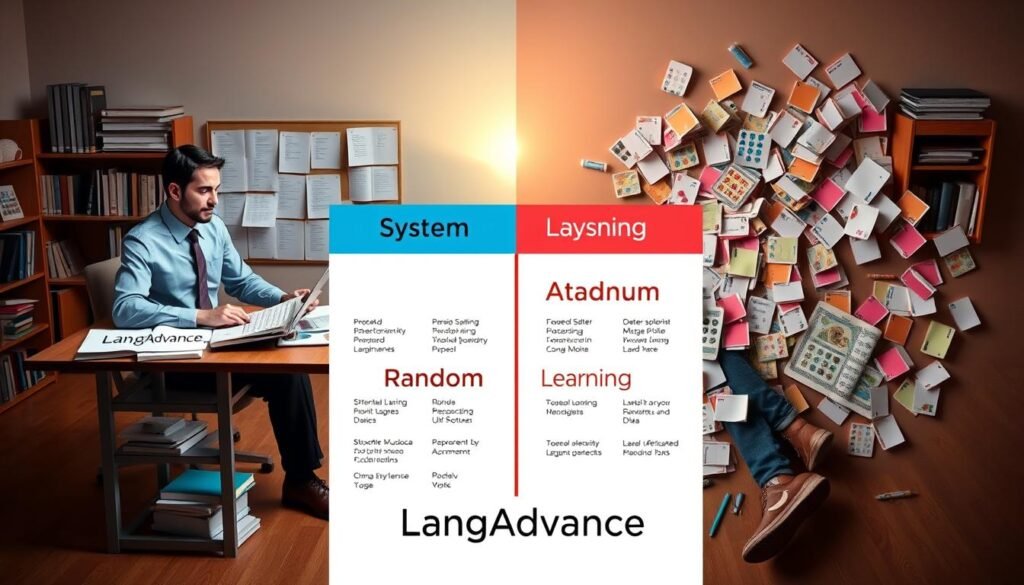
Quick comparison
| Metric | Structured system | Random learning |
|---|---|---|
| Outcomes | Tied weekly goals: input, vocab, grammar, and conversations aligned to your target. | Uneven skills; gaps appear where practice was accidental. |
| Time ROI | High — scheduled speaking with feedback and targeted reviews speeds gains. | Low — equal hours often wasted on unfocused apps or passive media. |
| Confidence | Rises quickly with regular, planned conversations and small wins. | Often delayed; sporadic practice prolongs anxiety about speaking. |
| Retention & errors | Spaced recycling and corrective feedback prevent fossilized mistakes. | Ad hoc study leads to forgotten items and persistent errors. |
| Progress tracking | Measurable improvements and clear next steps (we recommend tracking weekly). | Feels busy but progress is hidden. |
Research-backed fact: corrected conversation and timed practice produce higher ROI than solo courses or large, passive classes. For you as a learner, a system turns time into visible skill.
“Make your plan predictable and your study purposeful; the brain remembers what it uses.”
Tip: Tools like LangAdvance provide guided tasks, tutor feedback, and analytics so your hours become results, not busywork.
Common Myths That Derail Language Learners
Old assumptions about age, time, and apps often derail real progress for adult learners. We want to clear those belief traps and offer practical reframes you can use in daily life.
“I’m too old” and “I don’t have time”
Myth: Age or a busy schedule makes success unlikely.
Reality: Adults often learn faster when they use structure and focus. Your experience and discipline help you set clear goals.
Try a 15-minute minimum daily habit. Small, steady practice beats rare marathons and keeps momentum in your life.
“Apps alone are enough” and “speaking can wait”
Myth: Apps solve everything, or speaking is a later step.
Reality: Apps build recognition, but they don’t replace feedback. Early, low-stakes speaking shows gaps you can fix quickly.
Plan short tutor check-ins or exchanges. Use micro-topics and recycle phrases so lessons turn into usable speech.
- Carry a quick dictionary app for instant checks.
- Prepare 2–3 micro-topics before each short practice session.
- Accept some ambiguity—context teaches faster than perfection.
“Small, consistent practice and early speaking beat waiting for perfect understanding.”
| Common myth | Why it stalls you | Practical reframe |
|---|---|---|
| “I’m too old” | Leads to avoidance and low effort | Use structured goals and leverage life experience |
| “I don’t have time” | Causes sporadic, ineffective study | Commit to 15 minutes daily; stack with routine tasks |
| “Apps alone are enough” | Blocks corrective feedback and speaking practice | Pair apps with short, corrected conversations |
| “I must know every word” | Stops forward progress | Allow ambiguity; learn words in context and reuse them |
Tip: Reframe obstacles into systems. Schedule, simplify, and stack habits so learning new skills fits your life automatically. These small changes keep you moving and make learning language into a part of your routine.
Why LangAdvance Fits This Proven, Step-by-Step Path
LangAdvance packages the research into a clear, usable system you can follow every day. It balances comprehensible input with corrected conversation and short, focused form work so you move from recognition to real use.
Guided input, active output, targeted vocab and grammar, built-in consistency
We give you reading and audio that match your level, including graded texts and short extracts from books. That keeps input engaging and manageable.
Regular speaking slots connect you with tutors and native speakers who correct errors fast. Corrections turn practice into measurable gains.
- High-frequency words appear as phrases you use immediately.
- Micro-lessons teach the next grammar step, then push you to use it in speaking.
- Streaks, reminders, and micro-immersion prompts keep your daily rhythm even on busy days.
Progress tracking and tutor feedback for US-based learners’ schedules
Dashboards show what you’ve mastered and where to focus next so your study time stays efficient.
Sessions are bookable in US time zones, making it simple to keep consistent practice without reshuffling your life.
“Input feeds output, feedback feeds targeted reviews, and your system evolves as your goals change.”
Conclusion
Conclusion
Turn feedback and brief practice into predictable signals that guide your next step. Build a simple routine that fits your life and stacks small wins over time.
Prioritize comprehensible input, short corrected speaking, and light grammar work. This mix makes language learning efficient and lasting.
Focus vocabulary on high-frequency items, recycle phrases in real chats, and keep sessions short and steady. Track streaks so you keep momentum and clear next steps.
Let go of myths and choose systems, not shortcuts. With steady habits and the right feedback, you can start today and progress in your life toward using a new language with confidence.