


You can have strong motivation and still stall. Many people spend months in apps and books, then freeze in real conversation. That gap happens because speaking is a separate skill that needs real-time retrieval, not just passive input.
We’ll preview the frequent errors that slow your progress across beginner, intermediate, and advanced levels. Expect clear, familiar examples—like practicing vocabulary obsessively yet avoiding real chats—and practical fixes you can try this week.
Structure beats motivation on busy days. A simple system prevents hopping between tools, perfectionism, and inconsistent study. We promise a practical table that maps each mistake to its consequence and a concrete solution you can apply fast.
Throughout this piece we introduce LangAdvance as a step-by-step partner. We show how a 50/50 input/output balance, brief daily habits, and weekly speaking practice turn study time into real-world progress.
Key Takeaways
- Motivation helps, but structure keeps your journey moving on hectic days.
- Overusing apps without speaking often leads to freezing in conversation.
- Balance input and output: aim for short daily practice plus weekly speaking.
- Perfectionism and resource hopping waste time; use one clear system instead.
- LangAdvance offers a stepped plan to turn study into usable skill.
Why Motivation Without Structure Stalls Progress Today
Short bursts of enthusiasm don’t build steady skill. You may study hard on a high-energy day and then skip a week. That gap forces you to relearn basics and erodes progress.
Structure protects you on low-energy days. A simple process—habit stacking, minimal viable sessions, and a weekly plan—keeps your practice moving forward even when motivation fades.
Motivation fades; systems carry you on low-energy days
Try 10–15 minutes of focused practice when time is tight. Short sessions beat sporadic cramming and prevent the restart effect that wastes years of potential depth.
From “I’ll study later” to a repeatable plan that compounds
Attach study to a routine: after coffee, shadow a 3-minute clip. Schedule days by skill (Mon listening, Tue speaking). Limit tools to two or three resources for months so you build depth instead of hopping back to square one.
| Problem | Consequence | Quick Fix | Time |
|---|---|---|---|
| Motivation-only study | Long gaps, relearning basics | Use 10–15 min daily sessions | 10–15 min/day |
| Resource hopping | Shallow progress over years | Pick 2–3 core tools for 3+ months | 3 months |
| No weekly plan | Unfocused effort, stalled progress | Schedule skills by day (listen, speak, read) | 1 hour/week planning |
Common Language Learning Mistakes
What looks like solid study is often a set of habits that block usable progress. You might log hours in apps or read grammar guides and still freeze in real conversation.
Perfectionism, translation thinking, and constant resource switching are frequent culprits. They turn study time into planning time and delay real speaking practice.
Below is a short overview of patterns you’ll see at different stages. Later sections unpack fixes for beginners, intermediates, and advanced learners.
- Waiting to speak until “ready” keeps output skills underdeveloped; speaking must be practiced deliberately in context.
- Grammar obsession and translation dependency slow retrieval; training direct thought in the target tongue speeds speech.
- Passive input without output—endless videos or reading—limits recall; balance input with active production (50/50).
- Resource hopping and comparison drain time; stick to a small set of tools and track progress against your past self.
| Behavior | Why it hurts | Quick Fix | When to apply |
|---|---|---|---|
| Waiting to speak | Blocks retrieval practice | Weekly speaking goal (short tasks) | Start immediately |
| Grammar obsession | Causes analysis paralysis | Use grammar in real tasks, not only drills | During weekly sessions |
| Passive input only | No active recall | Summarize or teach what you read | Daily (10–20 min output) |
| Wrong-level material | Too easy or too hard kills flow | Aim for i+1 (70–80% comprehension) | Choose new content weekly |
Beginner Pitfalls: Fix These Early to Build Real Skills
Beginners often stall by stacking tools instead of speaking. You collect apps and guides but delay real output. That slows usable progress in a new language.
Overusing apps and hoarding resources
Cap your toolkit to two or three core resources for 90 days. Pick one app, one course, and one speaking partner.
Then force output: speak five minutes a day or write 5–7 sentences. This turns study into usable words.
Avoiding speaking until “ready”
Start speaking from day one. Read aloud, shadow short clips, and schedule a weekly 15-minute chat.
Record a 60-second monologue, listen back, and note the gaps. Imperfect practice builds confidence fastest.
Skipping the basics: weak foundations break under pressure
Treat basics as bricks: learn high-frequency words, starter grammar and a few simple grammar rules you’ll reuse.
Follow the 50/50 rule: for every 10 minutes of input, do 10 minutes of output. Use i+1 material at 70–80% comprehension.
- Celebrate small wins: order coffee, introduce yourself, ask three questions in week one.
Intermediate Traps: The Hidden Habits That Slow Your Target Language Progress
At the intermediate level most stalls come from habits that feel productive but don’t make you speak faster. You may study rules and parse grammar all day, yet your speech stays slow. That gap creates a frustrating plateau.

Shift focus to communication in context. Use grammar inside full sentences and short stories rather than isolated drills. Tell a past-tense story, then refine it with feedback. This trains retrieval, not just accuracy.
Turn passive time into active output. After reading or watching movies, record a two-minute summary and pose one question about the content. Post it to a group or bring it to a conversation partner.
- Describe a picture without translating — force direct thinking in the target tongue.
- Plan weekly speaking topics (work, travel, hobbies) to practice retrieval under pressure with varied speakers.
- One session: focus on a single grammar point across speak, write, and reflect mini-tasks.
| Trap | Why it stalls | Quick Fix |
|---|---|---|
| Grammar obsession | Analysis over use | Use grammar in stories and tasks |
| Passive input overload | No active recall | Summarize aloud after reading |
| Accent narrowness | Fail with native speakers | Listen to varied speakers and accents |
Track bottlenecks. If you understand but can’t respond fast, practice timed prompts and sentence frames. Increase difficulty slowly (i+1), add 100–150 word writing bursts, and you’ll restart measurable progress.
Advanced-Level Blind Spots: Plateau Breakers for Confident Communication
At advanced stages, the real stall often comes from tiny habits that quietly reset months of progress. Long breaks, squeezed study bursts, and ignoring pragmatic cues add up over time. You need a steady process to protect gains built over years.
Consistency and realistic horizons
Replace on/off cycles with a sustainable cadence. Aim for 20–30 minutes most days to avoid losing ground. Set quarterly goals, not weekly miracles, so you consolidate complex skills without burnout.
Culture, pragmatics, and fast listening
Make culture part of your weekly routine. Study register, humor, and politeness so your wording fits real situations.
- Train fast listening: watch short clips with target-language subtitles, then rewatch without them at native speed.
- Alternate intensive reading with paraphrasing aloud to link comprehension to speech.
- Use task chains: watch, note phrases, shadow, summarize, then use those phrases in live conversation.
Measure advanced progress
Track performance markers: a 5-minute spontaneous talk with minimal hesitation, or an expert-level monologue plus Q&A. These show real progress and guide the next part of your practice.
Mistake → Consequence → Practical Solution (Quick Chart)
Use this quick reference to map what slows your progress and how to fix it in one week. Scan the rows, pick three items you recognize, then act on one small change right away.
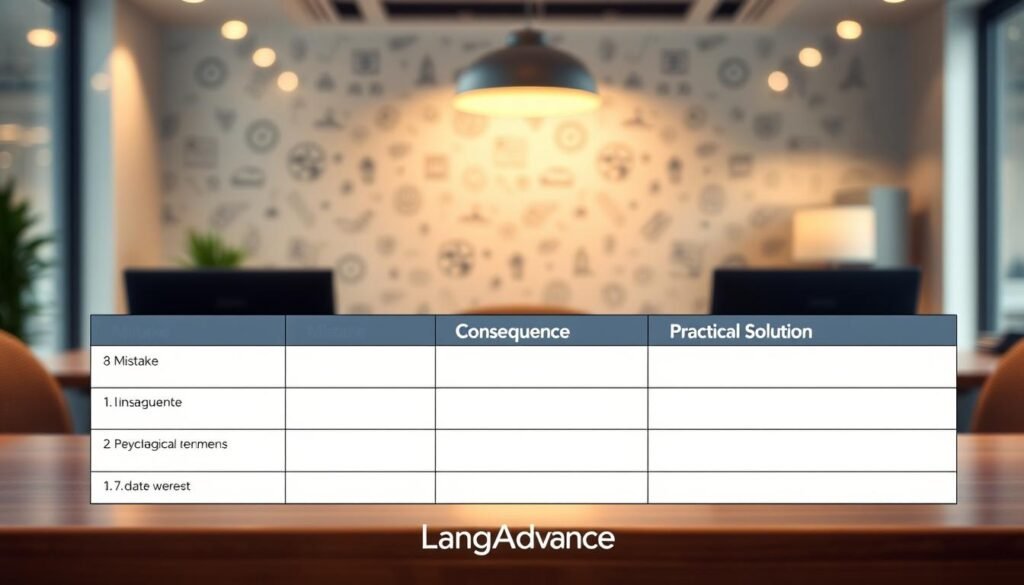
| Mistake | Consequence | Practical Solution | When to Apply |
|---|---|---|---|
| Perfectionist trap | Freezes in real talk | Speak weekly; record short clips | This week |
| Grammar obsession | Analysis paralysis | Use grammar in short stories/tasks | During weekly sessions |
| Passive input only | Output gap | Apply 50/50 rule: summarize aloud | Daily (10–20 min) |
| Resource hopping | Shallow progress | Commit to 2–3 core resources for 90 days | 90 days |
| Wrong level | Boredom or overwhelm | Choose i+1 (70–80% comprehension) | Weekly content check |
| Listening neglect | Miss fast speech | Daily 10 min varied accents; second pass no subs | Daily |
| Cultural neglect | Pragmatic errors | Study registers; role-play scenarios | Weekly |
| Inconsistency | Relearning | Daily 10–15 minutes habit stack | Daily |
| Unrealistic timelines | Burnout | Set quarterly milestones | Quarterly |
| Motivation dependency | Practice stalls | Habit stack + minimal viable session | Start today |
How to use this chart to diagnose and fix patterns fast
Scan the list, circle three issues you see in your routine, and star the one that blocks progress most.
- Schedule a small practice change for each chosen row (example: 15-minute conversation Friday at 6 PM).
- Track results next week; repeat or adjust.
“Small, consistent practice beats sporadic intensity.”
Structured, Step-by-Step Wins: Replace Random Practice with a System (with LangAdvance)
Replace scattered practice with a weekly system that turns study into steady progress. A clear routine balances input and output so you use what you study. We show a practical plan you can run each week.
Design a weekly routine
Aim for 50/50 input/output. For every article or movies clip you read or watch, make a short summary aloud or in writing. Pick i+1 content at 70–80% comprehension so you stretch without frustration.
Speak early and often
Schedule two speaking blocks: one live language exchange and one self-recorded monologue. Use task-based practice—summaries, role-plays, or a 90-second talk—to force retrieval in context.
Consistency engines
Use habit stacking and minimal viable sessions (10–15 minutes) to keep consistent practice on busy days. Tighten resources: choose two core tools plus one support item to avoid switching and deepen progress.
| Focus | Weekly Action | Why it helps |
|---|---|---|
| Input / Output balance | Watch one clip, summarize it aloud | Turns passive reading into usable speech |
| i+1 content | Pick texts at 70–80% comprehension | Builds new vocabulary and rules in context |
| Speaking blocks | One exchange + one self-recording | Improves fluency and tracks progress |
| Habit tools | 10–15 min sessions, habit stack | Ensures consistent practice every day |
“Small, repeatable systems beat scattered effort. Make a plan and run it weekly.”
LangAdvance packages these steps into weekly templates, task prompts, and a progress dashboard. Use it to track reading, listening, speaking, writing, vocabulary cycles, and your next steps with native speakers’ content at normal speed.
Conclusion
Wrap up your practice with one clear step you can do today to turn study into usable speech. Small, steady actions beat occasional intensity. Pair a simple weekly process with short daily sessions and your journey keeps moving.
Focus on essentials: high-frequency words, use-it-now vocabulary, and a few grammar rules you apply in real talk. Add culture and pragmatic cues so your tone fits real situations with native speakers.
When you hit a stall, adjust level (i+1) not goals. Track one change from the chart, test it for a day, and note progress. Structure wins where motivation fades.
We’re here to help. Use LangAdvance for step-by-step plans, weekly routines, and progress checks. Pick one 15-minute task now, speak it aloud, and keep your progress steady—one clear step at a time.