

Table of Contents
- Introduction
- Video Lesson: Master English Conversation – Pre-Intermediate Level
- Who This Course & Guide Are For
- What You Will Learn on This Pre-Intermediate Course
- Course Structure & Learning Method
- Using English Tenses Fluently
- Stative & Dynamic Verbs Explained
- Modal Verbs & Conditional Forms
- Articles: A, An, and The
- Linking Words for Better Sentences
- Gerunds, Infinitives & To-Infinitive
- Verbs with Similar Meanings (talk/speak/say/tell, see/look/watch)
- Vocabulary Topics & Sherlock Holmes Story
- Sample Pre-Intermediate Dialogues
- Practice Exercises
- Summary
- CTA – Move from Pre-Intermediate to Intermediate with LangAdvance
Introduction
You’ve finished beginner English and you can understand simple sentences, but you still don’t feel ready for intermediate
level. Sometimes tenses confuse you, articles (“a, an, the”) seem random, and you’re not sure when to use verbs like
say or tell, see or watch. If you recognise this, then
“Master English Conversation – Pre-Intermediate Level” is the perfect next step for you.
Taught by an experienced British native teacher with over 20 years in the classroom, this course helps you build a strong
grammar and vocabulary foundation so you can progress confidently to intermediate level. You study tenses, modal verbs, stative
vs dynamic verbs, conditional forms, articles, linking words, gerunds and infinitives – all linked to real-life topics like
holidays, food and drink, clothes, feelings, daily routines, and more.
This article is a detailed guide based on the course content. Use it while watching the lessons to review key points, understand
examples more deeply, and practise speaking out loud. If you follow both the video course and this guide, you will move from
pre-intermediate to intermediate faster and more confidently.
Video Lesson: Master English Conversation – Pre-Intermediate Level
Watch the course-related video here:
Who This Course & Guide Are For
This pre-intermediate conversation course is ideal for:
- Pre-intermediate students of English as a second language.
- Learners who finished a beginner level course and are ready for the next step.
- Students who understand simple grammar but get confused with tenses, conditionals, and articles.
- People who want to prepare for intermediate-level courses in grammar, conversation, or exam English.
There are no strict requirements, but if you are a complete beginner, it’s better to start with “Master English Conversation –
Beginner Level” first.
What You Will Learn on This Pre-Intermediate Course
By the end of this course, you will be able to:
- Use English tenses more fluently and confidently.
- Understand and use modal verbs, stative verbs, and dynamic verbs.
- Use conditional forms (first, second, and third conditional) correctly.
- Use articles (a, an, the) more naturally in conversation.
- Connect ideas with linking words like “however”, “because”, “although”, “so”.
- Understand how and when to use gerunds, infinitives, and to + infinitive.
- Choose the correct verb when meanings are similar (e.g. say/tell, talk/speak, see/look/watch).
The course includes 14 hours of on-demand video, 7 sections, and 42 lectures, plus quizzes after each lesson
and an engaging Sherlock Holmes story, Silver Blaze, split into chapters with comprehension activities.
Course Structure & Learning Method
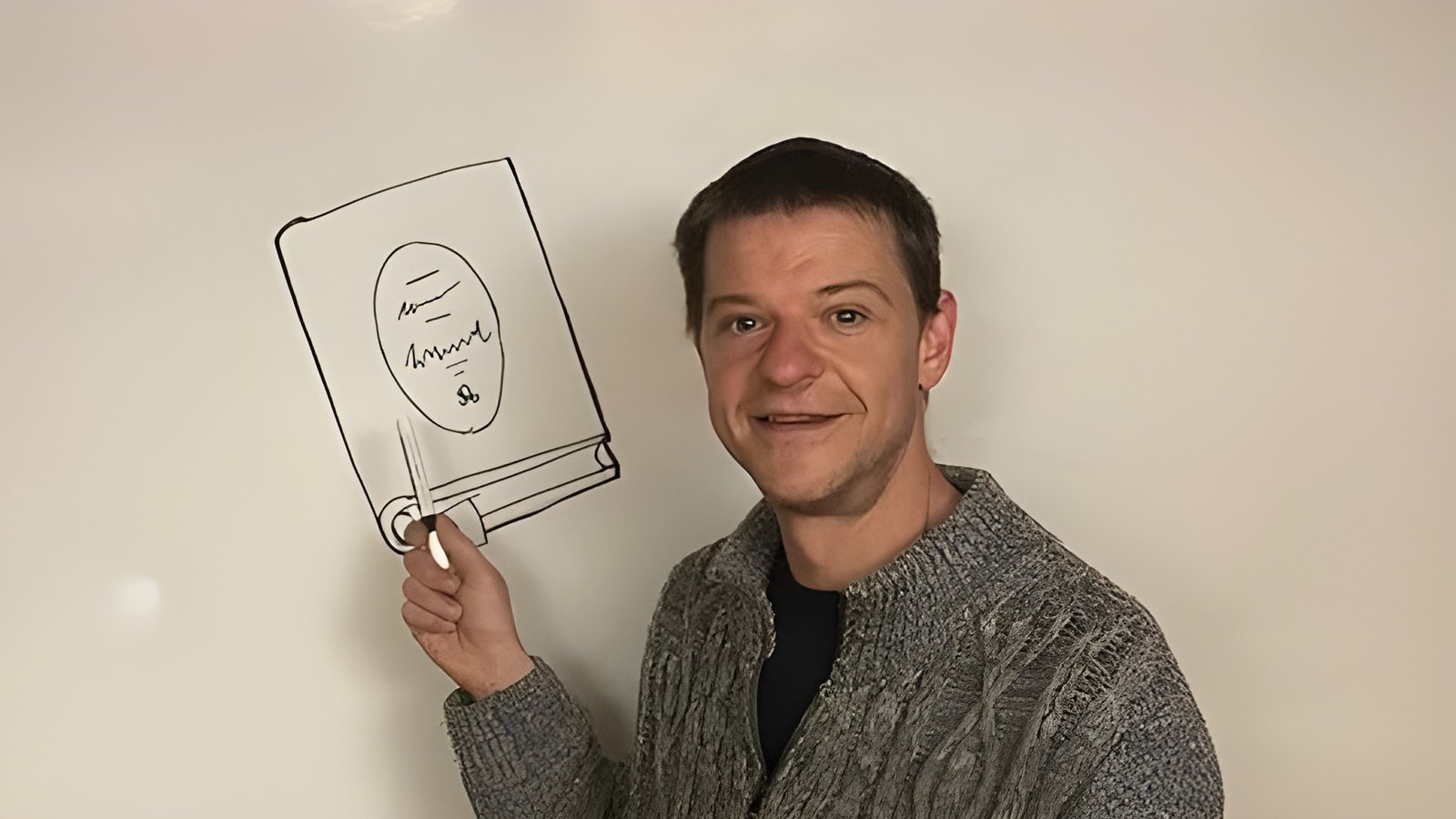
The teacher uses a whiteboard and pictures to explain grammar step by step, starting slowly and then speaking faster as your
listening improves. You will:
- Watch clear explanations of grammar topics (tenses, questions, conditionals, passive, etc.).
- Learn vocabulary through themes (body, food, clothes, holidays, feelings, money).
- Practise with more than 8 questions after almost every lesson.
- Listen to an adapted Sherlock Holmes story and answer comprehension questions.
- Repeat and review vocabulary in different lessons so it stays in your long-term memory.
The teacher encourages you to speak to your monitor – that means repeating sentences out loud and answering
questions as if you are in a real classroom. This active speaking practice is essential for improving conversation.
Using English Tenses Fluently
One of the main goals of the course is to help you feel more comfortable with English tenses. You start with the basics and
slowly add more complex forms.
Present Simple vs Present Continuous
In the first lessons, you learn when to use each tense:
- Present Simple – habits, routines, and facts:
- I get up at 7 a.m.
- She works in a bank.
- Water boils at 100°C.
- Present Continuous – actions now or temporary situations:
- I’m wearing a blue T-shirt today.
- They’re studying for their exams this week.
Past Simple vs Past Continuous
Later you compare past tenses, especially in the “Past Simple v Past Continuous” lesson:
- Past Simple – finished actions in the past: “I went on holiday last year.”
- Past Continuous – actions in progress at a time in the past: “I was reading a book when he called.”
Present Perfect vs Past Simple
You also study the difference between:
- Present Perfect – experiences and results: “I have visited London three times.”
- Past Simple – finished time: “I visited London in 2018.”
Past Perfect vs Past Simple vs Past Continuous
In a later lesson you add the Past Perfect to talk about actions that happened before another past action:
- When I arrived, they had already started dinner.
Stative & Dynamic Verbs Explained
A special focus of this course is the difference between stative and dynamic verbs. Understanding
this helps you use continuous tenses correctly.
Dynamic Verbs
Dynamic verbs describe actions you can see:
- run, eat, write, drive, speak, watch, play
- We can use them in continuous forms: “She is running”, “They are eating dinner.”
Stative Verbs
Stative verbs describe states (feelings, thoughts, possession):
- know, believe, like, love, hate, want, need, understand, have (for possession)
- We usually do not use continuous forms with these:
- Correct: “I know the answer.”
- Not natural: “I am knowing the answer.”
Modal Verbs & Conditional Forms
You practise modal verbs and different conditional forms to talk about possibilities, advice, rules, and unreal situations.
Modal Verbs
In “Will and won’t”, “Other modal verbs”, and later lessons, you work with:
- will / won’t – promises, offers, predictions:
- I will help you with your homework.
- It won’t rain tomorrow (I think).
- can / can’t – ability and possibility.
- must / have to – strong obligation.
- should / shouldn’t – advice.
- might / may / could – possibility.
Conditional Forms
You study:
- First Conditional – real future:
- If it rains, we will stay at home.
- Second Conditional – unreal present:
- If I had more time, I would learn another language.
- Third Conditional – unreal past:
- If she had studied harder, she would have passed the exam.
Articles: A, An, and The
Articles are difficult for many learners. This course dedicates a full lesson to “Articles” and uses lots of examples so you can
practise choosing a, an, or the.
A / An – Indefinite Articles
- Use a before a consonant sound: “a car”, “a house”.
- Use an before a vowel sound: “an apple”, “an hour”.
- We use them when we talk about something for the first time: “I bought a new shirt yesterday.”
The – Definite Article
- We use the when both speaker and listener know which thing:
- “Close the door, please.” (the door in this room)
- We often use the with superlatives: “the best”, “the biggest”.
- We use the when there is only one: “the sun”, “the moon”.
Linking Words for Better Sentences
To connect ideas and make your speaking and writing more fluent, you study linking words such as:
- because – reason: “I stayed home because I was tired.”
- so – result: “I was tired, so I went to bed early.”
- but – contrast: “I like chocolate, but I don’t like ice cream.”
- although – contrast: “Although it was cold, we went for a walk.”
- however – contrast between sentences.
- and / also – adding information.
Gerunds, Infinitives & To-Infinitive
In the “Gerunds and Infinitives” lessons, you discover which verbs are followed by verb + -ing, which take
to + infinitive, and where both are possible with a change in meaning.
Gerunds (Verb + -ing)
- I enjoy reading detective stories.
- She hates getting up early.
To-Infinitive
- I want to improve my English.
- He decided to stay at home.
Both Possible (Change of Meaning)
- remember doing – you did it and you remember the memory:
“I remember meeting her at that party.”
- remember to do – don’t forget to do something:
“Remember to lock the door.”
Verbs with Similar Meanings (talk/speak/say/tell, see/look/watch)
A key part of this course is understanding verbs that are very similar but used differently. This helps you sound more natural
and avoid common mistakes.
Talk vs Speak vs Say vs Tell
- talk – more informal, general:
- We talked for hours.
- speak – more formal, also used with languages:
- She speaks three languages.
- say – what words come out of your mouth:
- He said he was tired.
- tell – always with a person:
- He told me he was tired.
See vs Look vs Watch
- see – something comes into your eyes (not planned):
- I can see the mountains from my window.
- look – you move your eyes to focus on something:
- Look at this picture!
- watch – you look at something that moves:
- We watch TV every evening.
Vocabulary Topics & Sherlock Holmes Story
Vocabulary is taught through themes and stories. Throughout the course, you see topics like:
- Food and drink (plus much/little, many/few).
- Clothes and present continuous.
- The body and descriptions.
- Holidays and irregular verbs.
- Common verb phrases (daily routines, everyday actions).
- Feelings and -ed / -ing adjectives (“bored” vs “boring”).
- Money and prepositions.
You also listen to and read an adapted Sherlock Holmes story, “Silver Blaze”, in six chapters. After each
chapter, you answer comprehension questions so you can check how much you understand. This shows you that even at
pre-intermediate level, you can enjoy classics of English literature.
Sample Pre-Intermediate Dialogues
Dialogue 1 – Talking About Holidays (Holidays & Irregular Verbs)
A: Where did you go on holiday last year?
B: I went to Italy with my family.
A: Really? Did you see any famous places?
B: Yes, we saw the Colosseum and we ate a lot of pizza!
Dialogue 2 – Feelings and -ed / -ing Adjectives
A: How was the film?
B: It was really boring. I was bored after ten minutes.
A: Oh no! I thought it would be interesting.
B: The trailer was exciting, but the film wasn’t.
Dialogue 3 – Making a First Conditional Sentence
A: If it rains tomorrow, what will you do?
B: If it rains, I will stay at home and watch a film.
A: Good idea. If it’s sunny, I’ll go to the park.
Practice Exercises
Exercise 1 – Present Simple vs Present Continuous
Choose the correct form:
- Right now, I ________ (cook) dinner.
- She usually ________ (go) to work by bus.
- They ________ (watch) TV at the moment.
Exercise 2 – First or Second Conditional?
Complete the sentences:
- If I ________ (have) more free time, I ________ (learn) another language.
- If it ________ (rain) tomorrow, we ________ (stay) at home.
Exercise 3 – Articles
Fill in a, an, or the:
- We bought ____ new car last week.
- ____ car we bought is red.
- She is eating ____ apple.
Exercise 4 – Similar Verbs
Choose the correct verb (say / tell / talk / speak):
- He ________ me that he was tired.
- Can you ________ more slowly, please?
- We ________ about our plans for the future.
Summary
“Master English Conversation – Pre-Intermediate Level” is a complete next step after beginner English. It gives you strong
control over tenses, modal verbs, stative vs dynamic verbs, conditionals, articles, linking words, questions, and more. You
also build essential vocabulary for everyday life and practise realistic conversations, reading, and listening.
With 14 hours of video lessons, quizzes after each lecture, and the Sherlock Holmes story Silver Blaze, you get all the
tools you need to move from pre-intermediate to intermediate level. If you use this guide, speak out loud, and review your
notes regularly, your conversation skills will improve quickly and naturally.
CTA – Move from Pre-Intermediate to Intermediate with LangAdvance
Ready to keep going after this course? At LangAdvance, you can:
- Follow structured English courses from beginner to advanced.
- Download grammar summaries and verb lists for daily revision.
- Practise conversation with topic-based articles, dialogues, and exercises.
- Combine pre-intermediate and intermediate content to build strong, confident English.
Stay consistent, speak out loud as you study, and step by step you will master English conversation at higher levels.